Medical Emergency Preparedness in the Dental Office: A Practical Framework | WSS
Practice Operations
Practice Operations · Western Surgical and Sedation
Medical emergencies in dental practice are uncommon, but they are not rare enough to ignore. Surveys of practicing dentists consistently find that the majority will encounter at least one significant medical emergency during their career, and that many practices are less prepared than they believe they are.
Preparedness is not primarily about having the right equipment, though equipment matters. It is about having trained team members who know their roles, protocols that have been rehearsed rather than merely written, and the clinical judgment to recognize a developing emergency before it becomes critical.
This article provides a practical framework for emergency preparedness in general dental practice — with particular attention to practices that have expanded into surgical procedures and sedation, where preparedness requirements are heightened.
The Most Common Medical Emergencies in Dental Practice
Understanding which emergencies actually occur in dental settings allows practices to prioritize their preparation appropriately.
Syncope (fainting)
Vasovagal syncope is by a significant margin the most common medical emergency in dental practice. It is typically triggered by anxiety, pain, or the sight of injections or blood, and usually resolves quickly with appropriate positioning. Despite being generally benign, syncope requires prompt recognition and correct management to prevent injury from falling and to distinguish it from more serious conditions with similar presentations.
Hypoglycemia
Patients with diabetes who have taken their medication but eaten inadequately before an appointment can develop hypoglycemia during treatment. Symptoms include confusion, shakiness, sweating, and in severe cases loss of consciousness. Prompt administration of oral glucose resolves most episodes.
Hyperventilation
Anxiety-driven hyperventilation is common in dental settings and produces symptoms including tingling in the extremities, lightheadedness, and chest tightness that can be alarming to both patient and provider. Management is primarily reassurance and controlled breathing guidance.
Allergic reactions
Reactions range from mild localized responses to anaphylaxis. Latex, local anesthetics, and antibiotics are the most common triggers in dental settings. Anaphylaxis is a true emergency requiring immediate epinephrine administration and emergency medical services activation.
Cardiac events
Angina and myocardial infarction, while less common, represent the most serious emergencies encountered in dental practice. Recognition of chest pain, radiating discomfort, shortness of breath, and diaphoresis, followed by appropriate response, can be life-saving.
Seizures
Patients with known seizure disorders may experience a seizure during treatment, particularly if stressed or if they have missed medication. Management focuses on protecting the patient from injury and monitoring until the seizure resolves.
The most common emergencies are also the most survivable — provided the team recognizes what is happening and responds according to a protocol they have actually practiced, rather than one they have only read.
Required Emergency Equipment
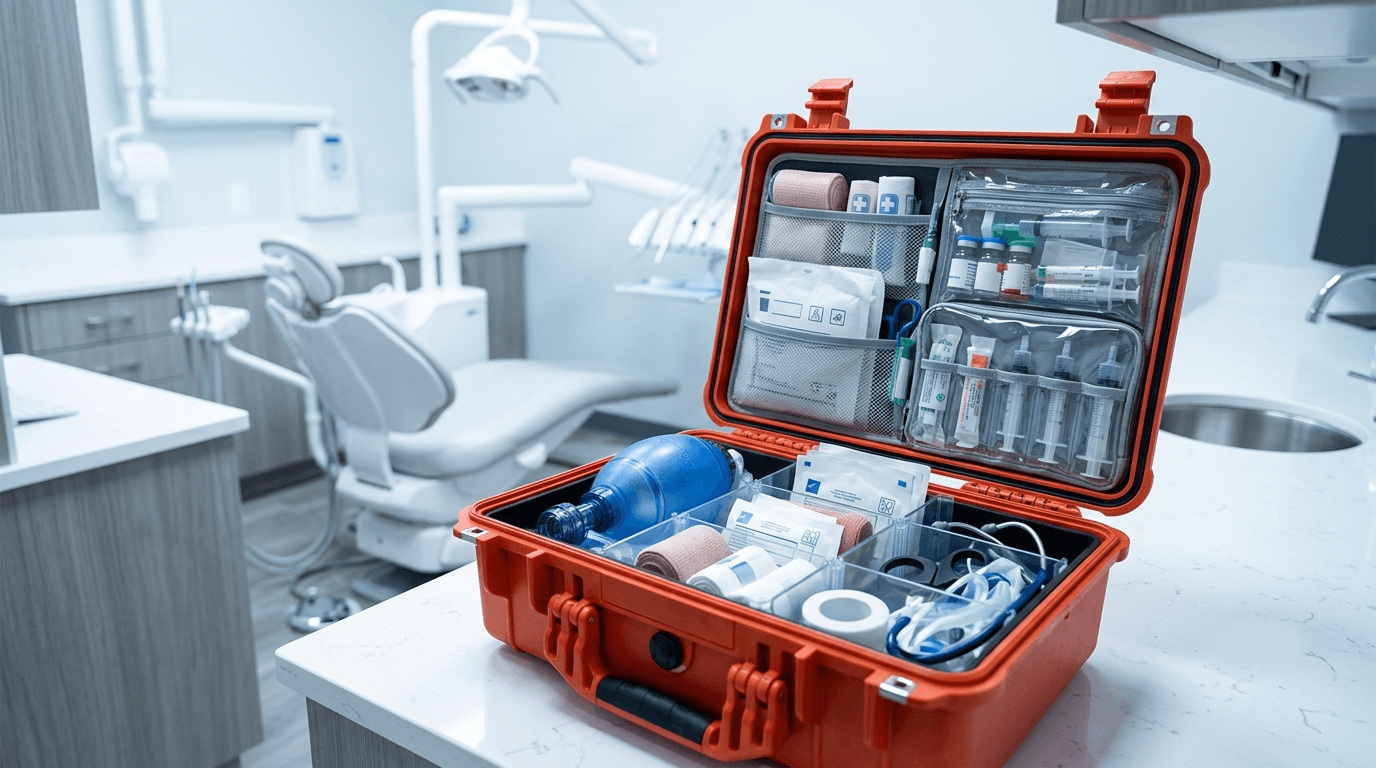
Emergency equipment requirements vary by state and are more stringent for practices offering sedation. The following represents a practical baseline for a general practice, with additional requirements noted for sedation providers.
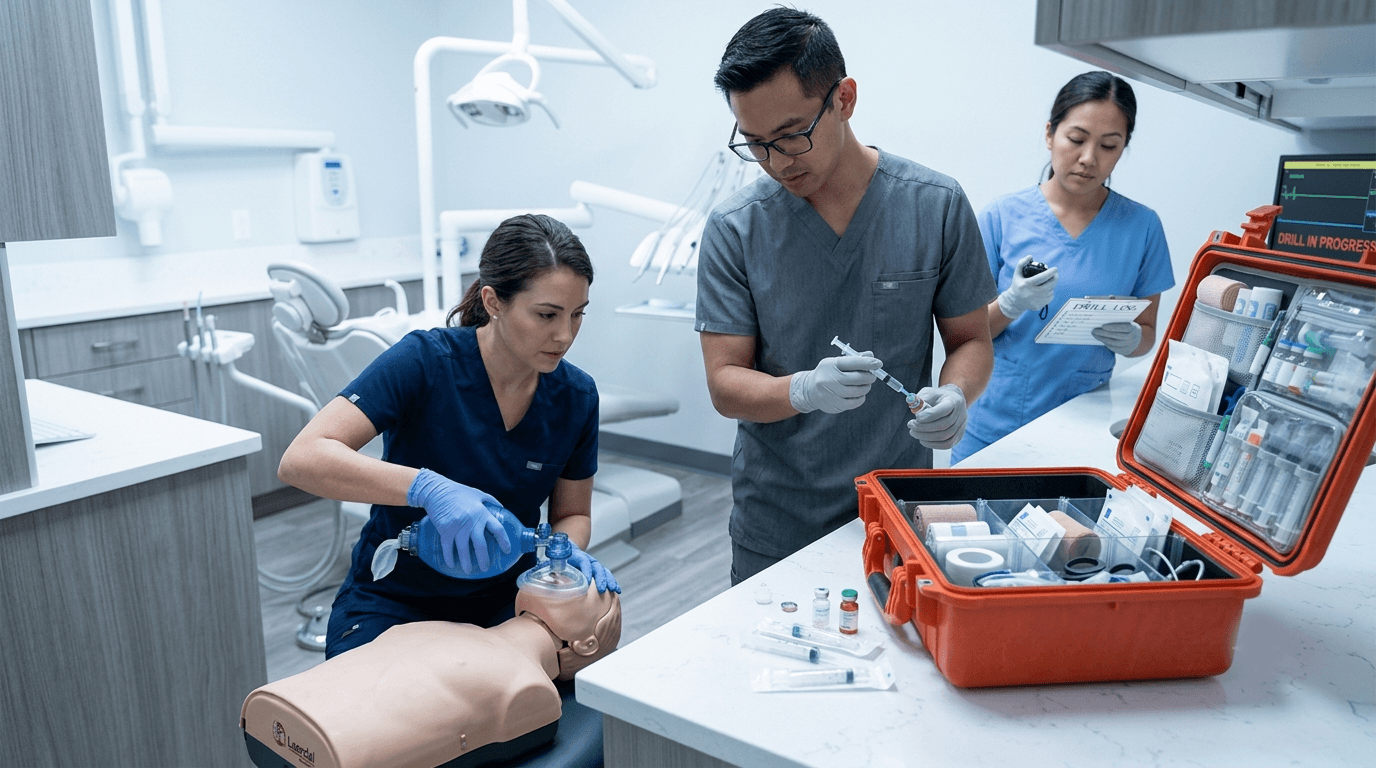
Emergency medications
Epinephrine (auto-injector or ampule) for anaphylaxis
Nitroglycerin for angina
Bronchodilator inhaler for bronchospasm and asthma
Oral glucose or glucose gel for hypoglycemia
Aspirin for suspected myocardial infarction
Diphenhydramine for mild to moderate allergic reactions
Equipment
Portable oxygen with delivery devices — nasal cannula, non-rebreather mask, and bag-valve mask
Automated external defibrillator (AED)
Blood pressure cuff and stethoscope
Pulse oximeter
Suction capable of clearing airway secretions
Additional requirements for sedation providers
Practices offering IV moderate sedation face significantly expanded requirements, typically including reversal agents for the sedation medications used, capnography for continuous ventilation monitoring, advanced airway management equipment, and a more comprehensive emergency drug inventory. These requirements are specified by your state's sedation permit regulations and should be verified directly against current requirements.
Training: The Component Most Practices Underinvest In
Equipment without training is decoration. The single most important investment in emergency preparedness is ensuring every team member knows exactly what to do.
BLS certification for all clinical team members
Basic Life Support certification should be current for every clinical team member without exception. Track certification expiration dates centrally to prevent lapses, and schedule renewal proactively rather than reactively.
ACLS for sedation providers
Advanced Cardiac Life Support certification is required by most states for dentists providing IV moderate sedation and is strongly recommended for the primary clinical support team in sedation practices.
Role assignment
In an emergency, ambiguity costs time. Every team member should have a pre-assigned default role: who initiates the response, who retrieves the emergency kit, who calls emergency services, who documents, who manages other patients in the practice. These assignments should be documented and posted.
Emergency Drills: Practice Before You Need It
Running emergency drills is the practice that most reliably separates prepared teams from unprepared ones. A team that has rehearsed a syncope response, an anaphylaxis response, and a cardiac event response performs measurably better than a team that has only read the protocol.
How to structure a drill
Drills do not require elaborate setup. A tabletop exercise where the team walks through a scenario verbally — identifying who does what, in what sequence — takes fifteen minutes and produces significant value. More realistic drills using a mannequin or a role-playing team member add further benefit.
How often
Quarterly drills are a practical standard for most practices. Practices offering sedation should consider more frequent drills, particularly during the first year of offering sedation, and should include sedation-specific scenarios such as respiratory depression and oversedation.
What to evaluate afterward
Did every team member know their role without prompting?
Was the emergency kit located and opened quickly?
Were medications and equipment where the team expected them to be?
Was anything in the kit expired or missing?
Would the protocol have worked if the dentist were not immediately available?
Documentation and Post-Emergency Protocol
Any medical emergency should be thoroughly documented in the patient record, including the presentation, the timeline of events, the interventions performed, the patient's response, and the disposition — whether the patient recovered in office or was transported.
A post-emergency team debrief serves the same purpose as a post-case debrief in surgical practice: capturing what worked, identifying what created friction, and updating protocols based on real experience rather than theory.
Practices should also review their emergency kit after any use, restocking anything consumed and verifying that expiration dates on remaining contents remain valid.
Frequently Asked Questions
How often should emergency kit contents be checked?
Monthly expiration date checks are a practical standard, with a designated team member responsible for the review. Many practices tie this to a recurring calendar reminder on the first of each month to ensure consistency.
Do requirements differ for practices offering sedation?
Significantly. Sedation providers face expanded equipment, medication, staffing, and training requirements specified by state dental board regulations. These requirements are part of the sedation permit process and should be verified against your specific state's current regulations, which are periodically updated.
Should the front office team be trained in emergency response?
Yes. Front office team members have important roles in an emergency — calling emergency services, directing paramedics to the correct operatory, managing other patients, and retrieving equipment. Their role should be explicitly defined and included in drills.
What should we do if an emergency exceeds our capability?
Activate emergency medical services immediately and continue supportive care within your training until they arrive. There is no scenario where delaying an EMS call to attempt further management independently is the correct decision. Early activation is always the appropriate response when the situation is escalating or uncertain.
Preparedness is part of clinical competency.
Western Surgical and Sedation's Sedation6 program includes emergency recognition and management as a core curriculum component — because knowing how to respond is inseparable from knowing how to sedate.
Learn more at westernsurgicalandsedation.com/courses




Related Articles
Related reading
Explore articles connected to surgical training, IV moderate sedation, and real world clinical decision making, selected to support dentists applying advanced care in daily practice.